As we all know, Mohamed Morsi and the Muslim Brotherhood won the 2012 Egyptian elections after former president (basically a dictator) Hosni Mubarak was ousted out of the government during the Arab Spring; until several months ago the Egyptian military still grasped on to a capacious amount of control over the Egyptian executive and parliament branches of the government effectively keeping the Muslim Brotherhood from gaining full power over the country. Now, according to the speakers of the Muslim Brotherhood, Morsi and his administration have most of the control and are trying to boost a waning Egyptian moral by "cleaning up the streets", producing propaganda tools like a Muslim brotherhood news channel, and attempting to re-establish a sense of nationalism and pride within the Egyptian government.
What I got out of the speech? Wherever the MB is going to take Egypt ideologically, economically, militarily, etc. is being hotly debated both within the ranks of the Egyptian government itself, the Egyptian people and by U.S. leadership. The speakers brought up the point that President Morsi will need to make the direly important decision soon of whether or not to try to cater to the Western states (who prefer to see Egypt remain a somewhat secular, pro-American country) or the recently 30% Salafi (far-right ultra-religious Islamic sect) parliament, or attempt a shot at appeasing both. In relation to the Browers excerpt, Democracy and Civil Society in Arab Political Thought, I question whether Morsi allow the Salafis to push Egyptian civil society back to a mujtama' al-ahli (traditional society), or will he and his administration somewhat break off from the main goal of the Muslim Brotherhood (which can be argued is to moderately Islamize society) and remain more along the lines of a mujtama' al-madani ("civic" society)?
Morsi's Administration, during mass protests (some of which turned extremely violent) in the Arab World against an anti-Islamic film, decided to go with the appeasement of both the West and the Islamists, and tweeted a duel condemnation of the violent protests in English and a condonation of the protests in Arabic. The US Embassy then drolly tweeted back a sarcastic response as seen below:
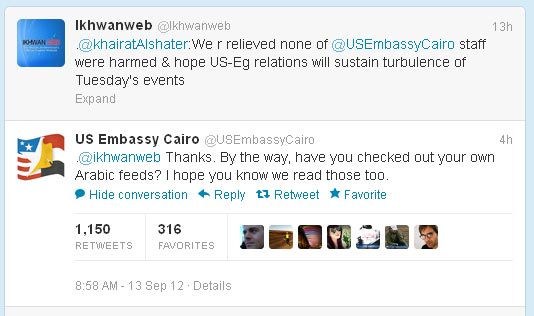
Source: http://news.yahoo.com/blogs/lookout/u-embassy-calls-muslim-brotherhood-conflicting-tweets-190521793.html
Obviously, this two-faced tactic will not always work for the newly elected Egyptian government as different U.S. Bureaucratic entities and other organizations are quite hawkish and will respond negatively to any perceived attempt at deceit. I believe that Morsi is starting to realize that the Islamic goals of the Muslim Brotherhood will have to follow suit later. As of right now, the more he blatantly ticks off the West, the higher the chances are that Morsi and his country will be thought of as just another Iran post-1979 and could end up somewhat isolated from the Western world. On the other hand, if Morsi were to politically backhand the Salafis, although a minority, they have quite a strong grasp of power in Egypt and could easily create some incredible barriers to the power of the Egyptian executive. For instance, the religious right could stir up even more violent protests around the country in response to negative action taken against them (an interesting article to read about the power of Salafis is in Foreign Affairs Magazine, although a subscription is needed to view the whole thing: http://www.foreignaffairs.com/articles/138129/william-mccants/the-sources-of-salafi-conduct).
Either way, it looks like Morsi is going to have to end up making someone angry.
It has been quite an interesting week and my stream of thoughts on the subject is gone for now. If anyone has any interesting articles or ideas about how Morsi could handle this massive problem, feel free to post here.

I wonder if they Morsi's cabinet could set up meetings with the West and the Salafi to come up with how they would like to build their future with Egypt, and then go from there to pick out the actions/policies/etc. that are similar to make both sides relatively happy. Have you heard of that being a possibility?
ReplyDeleteI haven't seen anything recently indicating any kind of across the table discussions between each party, but it is definitely possible it will occur at some point soon. However, it is still a little dubious that both parties will be satisfied with whatever plan Morsi attempts to implement even if trying to satisfy both the Salafi religious-right and the West. To me, the West and the Salafis are near polar opposites in the political realm and see through different prisms on how to establish what they each say is a "positive" reconstruction of Egypt and it's government. Still, sitting down and actually discussing everything together (without Morsi's administration acting in a hypocritical and/or deceptive manner like shown above) is always the best option.
ReplyDelete