First off- This Saturday I am meeting up with the blogger from The Moor Next Door, so if any of you have questions that you would like me to ask him, just hit me up with that.
Now that I have said that, Here goes my reflection.
I wanted to talk about the film 1/2 Revolution that I went to watch after last Thursday's class. I was not able to stay for the entire film but I was still able to gain a lot from the viewing. If you do not know anything about the uprising in Egypt, then it is good to research before seeing the movie because the movie focuses on the people's emotions and the experience rather than the details of what started this uprising. I was aware and also not aware of what had happened during the uprising in Egypt. I think it is very typical of westerners to view the Middle East as I do. We acknowledge that it is a real place and yet we distance ourselves from the Middle East and from the struggles of the people. We feel a wide range of emotions for the people but we have no empathy for them. It may sound stupid to others who have been more engaged in the Arab Spring, but watching this film was the first time that I had really thought about the struggle that the people had gone through or really felt anything for them. I felt a sense of empathy. Not in the sense that I could relate to them at all, but the thought of my being there and trying to keep my child away from the violence, seeing the people I love injured or killed in the process of fighting for what they believe in, and contemplating if I would be someone who was strong enough to go in the streets and protest. I am inclined to be honest and say that I would be too cowardly to fight, but then again, this is their freedom that they are standing up for...It's hard to grasp the concept of rather dying for a cause than living your life in submission. It is also very easy for us to forget that the US was a supporter of Mubarak....which that idea is still simmering in my head...so I have no other words for that.
Is Democracy always best? Yes, is the immediate answer. When you factor in time and place and how and who the people want, then the answer isn't so cut and dry.
Yay! for Egypt being free!!!...but Oh, they elect someone from the Muslim Brotherhood...right, ummm, yay?
Are we still advocates of democratization when the votes aren't towards people who want to be just like the US?
We can make this same examination of other countries in the Arab Uprising.
From my perspective, I want democracy for all people, but admittedly I want it for them the way that I have it. Their is a difference between the people of these countries and the people who will lead these countries in post-revolution. The people who will lead these countries, most likely, do not like us. Do we still want democracy for these people? Yes, because they are not the people who will lead their country. Does this mean that it is in our interest to try and influence the uprising? Whether or not it is in our interest to intervene...should we?
No....probably not....So we just let these people take control of these countries?
These are not rhetorical questions, as I have said before. I really am looking for some opinions so I can better shape my understanding.
Wednesday, October 10, 2012

Reflection #4
The recent attack of Malala
Yousafzai by the Pakistani Taliban has been upsetting and distressing for me.
The ninth grader gained fame in the past for a diary she wrote about the
Taliban and the harsh Islamic law it imposed in her city of Mingora until 2009.
Malala was shoot yesterday on the school bus on the way home; a Taliban gunman
entered the bus asking where she was, and she is now in a hospital in Peshawar.
The bullet in her spine has been removed and her condition is improving, and
many people are praying for her full recovery.
Though Pakistan is not considered
part of the MENA region, I still feel like the incident is relevant to this
class and the conflict in the MENA region as a whole. It is distressing to me
that a girl of only 14 years would be so brutally attacked. But what is even
more disturbing is that most major religious parties and mosque leaders have
been silent about the shooting, too fearful of Taliban retribution to come out
against the group for such a cruel attack. I understand that these religious
groups do not want to provoke the Taliban, because it is a powerful group
capable of killing and injury many. However, it is important for religious
groups to support the people and condemn the actions of the Taliban. Since
religious groups can be considered part of civil society in Pakistan, it is
important for them to act as allies to the people. When these groups stay silent
about acts like the one on Malala, it could be misconstrued as them
sympathizing with the Taliban instead of the victim.
In regards to sympathizing with the
Taliban, it is also dangerous for religious groups to stay silent about such
attacks because the western media focuses on their silence, which in turn shows
religion in Pakistan in a bad light. What with all of the other prejudices and
stereotypes westerners make regarding religion in the Middle East, situations
like this can only make it worse.
Structured Response #4
Both articles outline governmental systems of the Middle East.
One argues that social movements can produce fast acting change within these
states, while the other contends that there is not a strong enough existing
state in much of these areas.
Social movements across the Middle East can provide vast opportunities
as an avenue of democratic participation. The mobilization of socially and
economically disadvantaged groups is both easier done through grass roots
movements as well as done more effectively. These groups can organize political
participation through lobbying, voter registration, education initiatives and
leadership institutes. The structured inequalities of democracy can be
countered by these independent movements, which set agendas and prioritize
problems. The views of these groups are somewhat all encompassing; they can
focus on a wider array of issues and attract supporters with overlapping issue
concerns. The work of these movements can create and revitalize civil society
and the political representation they create increases trust in the government
and diversify the government’s policy. However, before social movements can
take shape, gain membership and align themselves with the government, the state
needs to have a strong and functional central government.
Anderson’s work brings to light the issue that although the
formation of these social movements has brought about change in other areas,
some states within the MENA region are not developed enough to produce change. While
some MENA states achieved secure administrative power, others did not. Since
the development of Middle Eastern states after the fall of the Ottoman Empire,
the government of states was not the center of social and political structure.
Peasant agriculture, close-knit ethnic groups and long distance trade made centralizing
the government nearly impossible. There are political units without statehood
such as the Palestine Liberation Organization or ethnic groups like the Kurds with
no means of political force or governmental outlet to express their views. The
idea that a state’s government can be used as a tool for supporting the needs
of societal actors does not take into account that the government’s choices are
determined by its’ ability to obtain resources. If the government is not strong
and functional, no amount of political pressure from societal groups will
influence its policies.
Reflection #4
After a federal judge overruled the Washington Metropolitan Area Transit's request to delay the use of a racially, politically, and religiously charged ad in the metro system, the ads were posted Monday. The ad makes sweeping generalizations about Muslims, referring to them as savages and urging the reader to "Support Israel. Defeat Jihad." The ad, run by the American Freedom Defense Initiative, was delayed but posted under the defense of the first amendment. The DC transit system pushed for the delay of this ad due to the recent and violent reaction to the online video, "Innocence of Muslims." Like so much of the American media, this ad ignores that majority of Muslims who support Jihad non-violently and uses marginal extremist examples to paint the picture of a violent and hateful Middle East. It is yet another factor playing into the growing American prejudice of the MENA region. The ad completely ignores the Muslim teachings of piousness and religious tolerance, but that would be counterproductive wouldn't it? If this ad had been offensive to Christians or Jews, would the response have been the same? There has been some protest in DC, one woman covered the sign with post-it notes that spelled out the sayings "Choose Tolerance" and "If you see something hateful, say something peaceful." The overall message is bigoted and unnecessary, especially in the nation's capital where so many different religions and cultures coexist.
http://www.latimes.com/news/nation/nationnow/la-na-nn-nyc-subway-ad-post-it-notes-20121009,0,6695941.story
http://www.latimes.com/news/nation/nationnow/la-na-nn-nyc-subway-ad-post-it-notes-20121009,0,6695941.story
Structured Response 3
History has revealed that social movements in the MENA region have occurred with varying degrees of success. It seems integral to realize the link between these social movements and the states that they have occurred in across the region in order to understand how these movements can function as an avenue for democratic participation in the region. The clearest way to analyze these relationships is to analyze past social movements and their successes with regard to their relationship to the state.
The two most important factors to understand, according to Lisa Anderson, deal with a state’s “construction” and its “form of bureaucracy.” That is to say: are smaller or larger states more conducive to social reform? Is a strong or weak model of bureaucracy more conducive to social reform? Past social movements reveal that the most successful movements leading to democratic participation have occurred in smaller states with a looser form of bureaucracy. This is most likely because the smaller population allows for more of an ease of communication, and a looser bureaucracy implies that there is a weaker central government and therefore more of an ability to effect positive change.
On the other hand, there are a few challenges that present themselves when viewing social movements as an avenue for democratic participation in the region. One of these is that one social activist group does not necessarily represent the desires of the entire population. This implies that even if a leader of a social movement group comes into power, that does not necessarily mean that the entire country would be happy with this regime change. There is more of a change for a potential civil war to break out, especially because there is no effective central government to keep different parties under control. Another challenge is that since a lot of social movement groups have diverted from the traditional hierarchy and moved to a more spread out leadership system, there may be difficulty trying to choose one leader to take control of the governing party. This indecision in the new government may lead to anarchy or military control of the state, two things that make the formation of another government more difficult to attain. It will be interesting to see how governments in these post-Arab spring states will form and continue to form in the future.
Thursday, October 4, 2012
Reflection #3- Muslim Brotherhood and Egypt
Honestly, it has been a productive but strange week for me in regards to learning more about civil society and the MENA region. Why "strange"? Because I went to what I thought was going to be a speech about the Muslim Brotherhood in Mary Graydon, however, it turned out that the lecture was partially by former/current members of the Muslim Brotherhood, the organization that has been outlawed in many countries and was formerly outlawed in Egypt. Even though I have never been a big fan of the Brotherhood I found what they had to say and what they had concluded to be quite interesting.
As we all know, Mohamed Morsi and the Muslim Brotherhood won the 2012 Egyptian elections after former president (basically a dictator) Hosni Mubarak was ousted out of the government during the Arab Spring; until several months ago the Egyptian military still grasped on to a capacious amount of control over the Egyptian executive and parliament branches of the government effectively keeping the Muslim Brotherhood from gaining full power over the country. Now, according to the speakers of the Muslim Brotherhood, Morsi and his administration have most of the control and are trying to boost a waning Egyptian moral by "cleaning up the streets", producing propaganda tools like a Muslim brotherhood news channel, and attempting to re-establish a sense of nationalism and pride within the Egyptian government.
What I got out of the speech? Wherever the MB is going to take Egypt ideologically, economically, militarily, etc. is being hotly debated both within the ranks of the Egyptian government itself, the Egyptian people and by U.S. leadership. The speakers brought up the point that President Morsi will need to make the direly important decision soon of whether or not to try to cater to the Western states (who prefer to see Egypt remain a somewhat secular, pro-American country) or the recently 30% Salafi (far-right ultra-religious Islamic sect) parliament, or attempt a shot at appeasing both. In relation to the Browers excerpt, Democracy and Civil Society in Arab Political Thought, I question whether Morsi allow the Salafis to push Egyptian civil society back to a mujtama' al-ahli (traditional society), or will he and his administration somewhat break off from the main goal of the Muslim Brotherhood (which can be argued is to moderately Islamize society) and remain more along the lines of a mujtama' al-madani ("civic" society)?
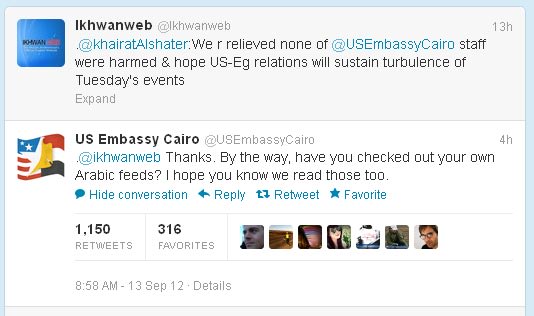
Morsi's Administration, during mass protests (some of which turned extremely violent) in the Arab World against an anti-Islamic film, decided to go with the appeasement of both the West and the Islamists, and tweeted a duel condemnation of the violent protests in English and a condonation of the protests in Arabic. The US Embassy then drolly tweeted back a sarcastic response as seen below:
Source: http://news.yahoo.com/blogs/lookout/u-embassy-calls-muslim-brotherhood-conflicting-tweets-190521793.html
Obviously, this two-faced tactic will not always work for the newly elected Egyptian government as different U.S. Bureaucratic entities and other organizations are quite hawkish and will respond negatively to any perceived attempt at deceit. I believe that Morsi is starting to realize that the Islamic goals of the Muslim Brotherhood will have to follow suit later. As of right now, the more he blatantly ticks off the West, the higher the chances are that Morsi and his country will be thought of as just another Iran post-1979 and could end up somewhat isolated from the Western world. On the other hand, if Morsi were to politically backhand the Salafis, although a minority, they have quite a strong grasp of power in Egypt and could easily create some incredible barriers to the power of the Egyptian executive. For instance, the religious right could stir up even more violent protests around the country in response to negative action taken against them (an interesting article to read about the power of Salafis is in Foreign Affairs Magazine, although a subscription is needed to view the whole thing: http://www.foreignaffairs.com/articles/138129/william-mccants/the-sources-of-salafi-conduct).
Either way, it looks like Morsi is going to have to end up making someone angry.
It has been quite an interesting week and my stream of thoughts on the subject is gone for now. If anyone has any interesting articles or ideas about how Morsi could handle this massive problem, feel free to post here.
As we all know, Mohamed Morsi and the Muslim Brotherhood won the 2012 Egyptian elections after former president (basically a dictator) Hosni Mubarak was ousted out of the government during the Arab Spring; until several months ago the Egyptian military still grasped on to a capacious amount of control over the Egyptian executive and parliament branches of the government effectively keeping the Muslim Brotherhood from gaining full power over the country. Now, according to the speakers of the Muslim Brotherhood, Morsi and his administration have most of the control and are trying to boost a waning Egyptian moral by "cleaning up the streets", producing propaganda tools like a Muslim brotherhood news channel, and attempting to re-establish a sense of nationalism and pride within the Egyptian government.
What I got out of the speech? Wherever the MB is going to take Egypt ideologically, economically, militarily, etc. is being hotly debated both within the ranks of the Egyptian government itself, the Egyptian people and by U.S. leadership. The speakers brought up the point that President Morsi will need to make the direly important decision soon of whether or not to try to cater to the Western states (who prefer to see Egypt remain a somewhat secular, pro-American country) or the recently 30% Salafi (far-right ultra-religious Islamic sect) parliament, or attempt a shot at appeasing both. In relation to the Browers excerpt, Democracy and Civil Society in Arab Political Thought, I question whether Morsi allow the Salafis to push Egyptian civil society back to a mujtama' al-ahli (traditional society), or will he and his administration somewhat break off from the main goal of the Muslim Brotherhood (which can be argued is to moderately Islamize society) and remain more along the lines of a mujtama' al-madani ("civic" society)?
Morsi's Administration, during mass protests (some of which turned extremely violent) in the Arab World against an anti-Islamic film, decided to go with the appeasement of both the West and the Islamists, and tweeted a duel condemnation of the violent protests in English and a condonation of the protests in Arabic. The US Embassy then drolly tweeted back a sarcastic response as seen below:
Source: http://news.yahoo.com/blogs/lookout/u-embassy-calls-muslim-brotherhood-conflicting-tweets-190521793.html
Obviously, this two-faced tactic will not always work for the newly elected Egyptian government as different U.S. Bureaucratic entities and other organizations are quite hawkish and will respond negatively to any perceived attempt at deceit. I believe that Morsi is starting to realize that the Islamic goals of the Muslim Brotherhood will have to follow suit later. As of right now, the more he blatantly ticks off the West, the higher the chances are that Morsi and his country will be thought of as just another Iran post-1979 and could end up somewhat isolated from the Western world. On the other hand, if Morsi were to politically backhand the Salafis, although a minority, they have quite a strong grasp of power in Egypt and could easily create some incredible barriers to the power of the Egyptian executive. For instance, the religious right could stir up even more violent protests around the country in response to negative action taken against them (an interesting article to read about the power of Salafis is in Foreign Affairs Magazine, although a subscription is needed to view the whole thing: http://www.foreignaffairs.com/articles/138129/william-mccants/the-sources-of-salafi-conduct).
Either way, it looks like Morsi is going to have to end up making someone angry.
It has been quite an interesting week and my stream of thoughts on the subject is gone for now. If anyone has any interesting articles or ideas about how Morsi could handle this massive problem, feel free to post here.
Reflection #3
With the upcoming election nearing and the Presidential debates starting, our country is focusing more on domestic politics lately and I thought I'd talk about last night's debate. What bothers me about these debates is the amount of false statements made. Last night especially, the debate was filled with facts. It began with Obama's claim that over the last 30 months 5 million jobs have been created (which is true, but that many were lost in his first year in office) and continued throughout to be packed with statistics. Both men made false claims, and I think it's interesting to go back and read the fact-checks after the debate. Although Romney was said to have shown a stronger presence, many of his statements were partially untrue, the must frustrating of which were his claims about tax cuts. Regardless of who said what, and what was true, it's scary to think that those who base their vote off of the results of these debates are being misinformed. How can we be happy with our president in office if we don't know who were truly voting for?
Subscribe to:
Posts (Atom)