Thursday, October 4, 2012

Reflection #3- Muslim Brotherhood and Egypt

Honestly, it has been a productive but strange week for me in regards to learning more about civil society and the MENA region. Why "strange"? Because I went to what I thought was going to be a speech about the Muslim Brotherhood in Mary Graydon, however, it turned out that the lecture was partially by former/current members of the Muslim Brotherhood, the organization that has been outlawed in many countries and was formerly outlawed in Egypt. Even though I have never been a big fan of the Brotherhood I found what they had to say and what they had concluded to be quite interesting.

As we all know, Mohamed Morsi and the Muslim Brotherhood won the 2012 Egyptian elections after former president (basically a dictator) Hosni Mubarak was ousted out of the government during the Arab Spring; until several months ago the Egyptian military still grasped on to a capacious amount of control over the Egyptian executive and parliament branches of the government effectively keeping the Muslim Brotherhood from gaining full power over the country. Now, according to the speakers of the Muslim Brotherhood, Morsi and his administration have most of the control and are trying to boost a waning Egyptian moral by "cleaning up the streets", producing propaganda tools like a Muslim brotherhood news channel, and attempting to re-establish a sense of nationalism and pride within the Egyptian government.

What I got out of the speech? Wherever the MB is going to take Egypt ideologically, economically, militarily, etc. is being hotly debated both within the ranks of the Egyptian government itself, the Egyptian people and by U.S. leadership. The speakers brought up the point that President Morsi will need to make the direly important decision soon of whether or not to try to cater to the Western states (who prefer to see Egypt remain a somewhat secular, pro-American country) or the recently 30% Salafi (far-right ultra-religious Islamic sect) parliament, or attempt a shot at appeasing both. In relation to the Browers excerpt, Democracy and Civil Society in Arab Political Thought, I question whether Morsi allow the Salafis to push Egyptian civil society back to a mujtama' al-ahli (traditional society), or will he and his administration somewhat break off from the main goal of the Muslim Brotherhood (which can be argued is to moderately Islamize society) and remain more along the lines of a mujtama' al-madani ("civic" society)?

Morsi's Administration, during mass protests (some of which turned extremely violent) in the Arab World against an anti-Islamic film, decided to go with the appeasement of both the West and the Islamists, and tweeted a duel condemnation of the violent protests in English and a condonation of the protests in Arabic. The US Embassy then drolly tweeted back a sarcastic response as seen below:
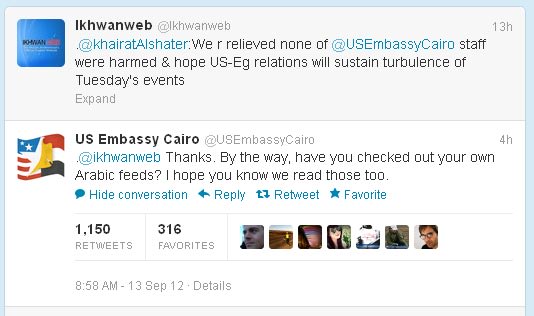


Source: http://news.yahoo.com/blogs/lookout/u-embassy-calls-muslim-brotherhood-conflicting-tweets-190521793.html

Obviously, this two-faced tactic will not always work for the newly elected Egyptian government as different U.S. Bureaucratic entities and other organizations are quite hawkish and will respond negatively to any perceived attempt at deceit. I believe that Morsi is starting to realize that the Islamic goals of the Muslim Brotherhood will have to follow suit later. As of right now, the more he blatantly ticks off the West, the higher the chances are that Morsi and his country will be thought of as just another Iran post-1979 and could end up somewhat isolated from the Western world. On the other hand, if Morsi were to politically backhand the Salafis, although a minority, they have quite a strong grasp of power in Egypt and could easily create some incredible barriers to the power of the Egyptian executive. For instance, the religious right could stir up even more violent protests around the country in response to negative action taken against them (an interesting article to read about the power of Salafis is in Foreign Affairs Magazine, although a subscription is needed to view the whole thing: http://www.foreignaffairs.com/articles/138129/william-mccants/the-sources-of-salafi-conduct).

Either way, it looks like Morsi is going to have to end up making someone angry.

It has been quite an interesting week and my stream of thoughts on the subject is gone for now. If anyone has any interesting articles or ideas about how Morsi could handle this massive problem, feel free to post here.

Reflection #3

With the upcoming election nearing and the Presidential debates starting, our country is focusing more on domestic politics lately and I thought I'd talk about last night's debate. What bothers me about these debates is the amount of false statements made. Last night especially, the debate was filled with facts. It began with Obama's claim that over the last 30 months 5 million jobs have been created (which is true, but that many were lost in his first year in office) and continued throughout to be packed with statistics. Both men made false claims, and I think it's interesting to go back and read the fact-checks after the debate. Although Romney was said to have shown a stronger presence, many of his statements were partially untrue, the must frustrating of which were his claims about tax cuts. Regardless of who said what, and what was true, it's scary to think that those who base their vote off of the results of these debates are being misinformed. How can we be happy with our president in office if we don't know who were truly voting for?

Wednesday, October 3, 2012

Reflection #3


            After watching the presidential debate tonight, I am even more looking forward to future debates when the candidates talk about foreign policy issues as opposed to the domestic issues that were discussed tonight. However, the debate still got me thinking about civil society in the Middle East mainly through the topic of education, which was a popular subject during tonight’s event. For the past two weeks I have spent time researching education in Saudi Arabia for the country brief this week, and I find it to be a very important topic when it comes to democratization in the Arab world. Many politicians in the US like to talk about education being “the future” and as cliché as it sounds, it really is true. In the Middle East, a strong educational system, for both men and women, is vital and needs to be developed. Education is the future; as we saw in the Arab Spring protests, many of the protestors supporting democratization were of younger generations. With educational improvement, young men and women from the Middle East can become informed on many issues and develop their owns beliefs and opinions about government. Without education, people cannot be exposed to new ideas and hence the norms that have long been established stay in place. Now that many of those norms have been shattered with the Arab Spring, the surge of new ideas has to continue – and that begins with education. 

Structured Response #3

            Civil society has a mainstream view as an entity separate from the state, and usually opposing the state or some of the states policies to promote democratic ideals. However, the line between civil society and the non-democratic state become blurred when some civil society organizations are associated with the state or another traditionally non-democratic organization.
            Saad Eddin Ibrahim, the director of the Ibn Khaldun Center for Developmental Studies in Egypt, viewed civil society in the traditional way – as a “voluntary, nongovernmental association.” He believes that any definition of civil society other than the traditional, liberal American view would result in a “watering down of the analytical value of the concept.”
However, many scholars argue that a different kind of civil society is more beneficial to the Arab world because the Middle East is completely different from the western world where the mainstream concept of civil society first emerged. Wajih Kawtharani describes himself as a “liberal Muslim,” a concept that is confusing for many who associate religion with anti-democratic ideals. However, Kawtharani believes that Islam and democracy can work together. Holding a similar belief is Tariq Ramadan, who I saw speak at an event earlier this month. Ramadan believes that many of the moral concepts from Islam can be applied to the government and help form democracy. He believes that being a “Muslim democrat” is not impossible; in fact, he sees religion as a possible positive influence for civil society and the development of democracy. Ramadan would likely see religious societies as an important part of civil society whereas some western liberals do not views those types of organizations as part of civil society.
The emerging importance of non-traditional civil society organizations in the Middle East is confusing because some of the organizations do not seem to jive with democratic concepts. There is a gray area as to which organizations are actually pro-democracy and which are not. However, it is important not to classify certain organizations as opponents of democracy simply because they have religious affiliations or any other type of questionable bias. 

Tuesday, October 2, 2012

Reflection #3- Hanna

I know that it is a little early in the week to be doing my reflection, but I just came back from an event at the Wilson Center, titled, 'Women after the Arab Awakening'. I wanted to share everything I learned with you while it was still fresh on my mind.
  It was a day long event, so I was only able to stay for the first panel. This panel was called, 'Today's View from the Ground'. The moderator of this discussion was Haleh Esfandiari. The speakers were as follows:
     Dalia Ziada, from Egypt, who we may know as the woman in the pink scarf. She is the executive director for the Ibn Khaldun Center for Development Studies.
     Omezzine Khélifa, from Tunisia. She is a politician and advisor to the Ministry of Tourism.
     Rihab Elhaj, from Libya. She is the Co-founder and executive director of the New Libya Foundation.
     Fahmia Al Fotih, from Yemen. She is a communication analyst and youth focal point analyst at the UNPF
     Hala Al Dosari, from Saudi Arabia. She is a Ph.D. candidate in health services research, also she is an opinion writer for online and print media. She is a blogger and advocate for Saudi women's rights.

    First, Esfandiari opened the panel by posing this question, 'is the issue of women's rights in MENA being marginalized?'. She also said that though we are relayed the information that women are apart of this process of revolution, the people on the ground have a much different take and they are proceeding with a cautious optimism. 
She then gave the floor to the first speaker, Dalia Ziada. She believes that though there is a risk in Islamist politicians, Egypt is not Iran or Saudi Arabia. Suzanne Mubarak did much work for Women's rights and brought about laws allowing women to give nationality to her child and that she may divorce her husband. I found this to be an interesting tid-bit since many of you, like me, probably did not know this. Though, I also went into this knowing next to nothing about Egypt. Ziada says that the culture is what is holding women back and grassroots action is necessary to see change. Dalia closed with her belief that the spring is not a success to her until she sees a woman in a position of power in one of the countries. Comparing women to flowers, Ziada says that their can be no spring without flowers.
  Omezzine posed this question of Tunisia-- How are women's roles evolving?
Keeping with the theme of social media, I found it really interesting when she mentioned that Facebook was often a faster source than the media in Tunisia. It has been one year since the democratic elections in Tunisia and though people had said that women's rights were a last concern-- the women in parliament said hell no and strove forward, pushing for progress. As Tunisia stands now they have a misogynist society and women are seen as complimentary to men as opposed to equal. Omezzine closed with that Tunisia needs to move from state feminism to political feminism.
   Rihab Elhaj says that women in Libya are being further marginalized. Many women are ambivalent with a mentality of 'it is what it is'. She spoke of the unarmed protests demanding the disbandment of violent non-state organizations. Rihab says the lack of female representation is from hesitance on the female part. This is because of a major problem with gender segregation and public harassment. Women are forced to either swallow their pride or stay at home. Rihab says that women are being marginalized in cultural and social life. 
   Fahmia Al Fotih used a statistic that 4 out of 5 women in Yemen claim that life has worsened in the past 12 months. The priority to women at the moment is food, security, and jobs. Al Fotih says the situation is only getting worse. Though women have been largely present at the protests-- they are veiled and so Al Fotih considers that they are not really there. Women protesters and activists are being attacked and beaten. Fundamentalist women are attacking other female protesters. Women protesters and doctors are being kidnapped. She spoke of the kidnapping of Tawakkol Karman and the woman named Bushra Al-Maqtari who has a fatwa on her that says if she is killed than the assailant has a ticket to heaven. Fahmia quotes UN Envoy, Jamal Bin Omar, who said, "Political parties disagree on everything, but they agree on marginalizing woman." 
   Al Dosari used her time to tell personal stories and stories of other woman in Saudia Arabia. She told the story of a women who took a video of her arguing with a religious officer who was telling her to go cover up. She used these stories for two reasons. One, the impact of empowerment and that all of the women must fight for their rights even if it is through small actions. Second, that the iron thumb of Saudia Arabian government makes it impossible for women to earn rights. All attempts they make eventually get squashed.

Though they all came from different situations, all of the speakers agreed that one of the best directions towards women's equality is to change the male mind set. During the uprising, no one paid mind to the women and they felt free. This is because the men had nothing to worry about, but now that governments are being set up, these men want to have something 'beneath them' to say 'I am higher than you'.  So it boils down to a matter of cultural change and a renewed view of the woman's role, which is far in the distance, but possible. The issue of women's rights in the MENA is going to an on going battle in years and years to come and will not be solved overnight. With the persistence and dedication of accomplished women such as those who spoke at this event, then women's equality will one day be achieved in these countries.

Structured Response #3- Hanna

   Before reflecting on the legitimacy and authenticity of the civil society of the MENA region, it is helpful to reflect on the characteristics of our own civil society. To what extent are our political and non-political groups intertwined? For instance, the relations of political groups and religious/social groups in the United States are deeply rooted in one another. Here we see the same "contentious and messy process of alliance building between groups actively working towards gaining political power (such as political elites and parties) and groups working on the framework for politics (such as NGOs)" as we see in the US. We, as a public, recognize these groups as legitimate and fundamental parts of our society. Why would this be any different in another part of the world? Why do we not question this the way we question the civil society of MENA countries?
    For Civil Society actors to be able to claim legitimacy in their society means for them to further their agenda and it provides a basis for idle behavior. It is like choosing Coke over Shasta: Shasta is only sold in pockets of the country, while Coke is a nationally recognized product. Apply that thinking to Civil Society actors. If a CSO can be recognized throughout its state as a fundamental and unwavering figure than they can only increase in power and they will be able to further their ideals. 
    If you only ever buy Coke then you won't ever know if you like Shasta. That is the problem that arouses from having these concrete Civil Society actors. Why would Coke change its formula or start advertising more if it doesn't have Shasta coming up as a competitor? I'm not sure if my analogy is making any sense, but what I am getting at is this: Constant change, evolution, and the challenge of other civil society actors saying 'Hey, I can do more for the people' is what brings about a vibrant civil society. A vibrant civil society is the key to democratization. The people of the MENA region need new civil society players to come out and say 'I can do more' if they want to continue on a path to democratization.
    As the area stands right now (from my humble understanding), the political and non-political groups are so heavily intertwined with members of the state that they may be comfortable. They can bicker among themselves and cut each other deals without any serious trouble coming from it and without anything of substance getting accomplished. In order for democratization to be furthered, something must come along and uproot those ties. Shasta needs to start advertising, essentially. The people are equally responsible, for if they accept these CSO's as organic parts of society than nothing will happen. The people need to demand Shasta be sold nationwide. Shasta, in this case, is a political or non-political group that is not intertwined with members of the state. Since Shasta is not rooted with members of the state, then they must work twice as hard to earn legitimacy in the Civil Society. This leaves no room for idle behavior and deal cutting.
    Not sure exactly how to wrap this up....or if my analogy makes any sense outside of my own brain. The problem with the civil society (in most nations, not exclusive to the MENA) is that it has become a part of the political sphere. Everything is intertwined and that leaves the public out of the decision making. Which doesn't exactly flow with the idea of democracy.

Monday, October 1, 2012

Structured Response 2


Civil society actors claim legitimacy from their ability to culturally and socially associate themselves with the people of a state. In order for them to be ‘organic’ parts of broader society, they would need to have the same values that mainstream society has. For example, many civil society actors in the MENA region have Arab values as opposed to Western ones, and therefore claim legitimacy from the fact that these actors stem from every day people with traditional values and a common culture and heritage with the rest of the citizens of that state. People are most likely going to associate with and support a civil society group that reflects their own thoughts as opposed to one that brings up new values and customs that people are not used to.
However, if civil society actors are inherently ‘organic,’ that is, they stem from customs, values, and norms that are already established, how are they effectively opposing the influence of the state? This question is one that seems to “throw a wrench” in the mainstream model of civil society’s role in democratization. Some may argue that civil society does not inspire change because it is already embedded in a society. Contrarily, I would argue that even though civil society actors are founded upon values that are common to the people of a state as a whole, there are differences in these values. These differences, such as a push for more women’s rights for example, are the ones that create change. Civil society actors are only able to make such influential change because at their base, they are able to relate to citizens of a state. Once citizens of a state are comfortable embracing civil society actors because of their foundational values, they begin to realize the true chances that civil society actors are attempting to bring about. Civil society actors seem to take the best of the old and combine it with their sense of dynamic idealism about the new.